Hydrogen 1 Protons Neutrons Electrons

Alright, picture this: you're at a fancy dinner party, and the host, a rather eccentric scientist, starts talking about the building blocks of the universe. Now, you could eit...
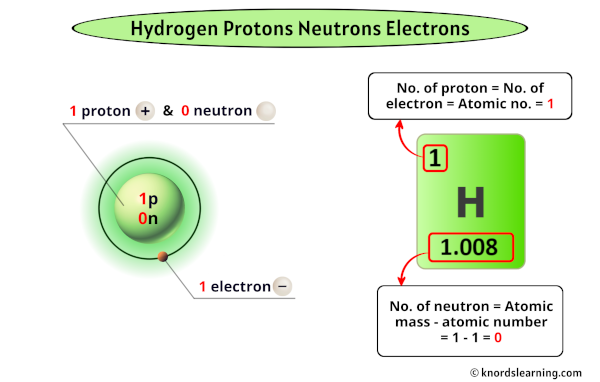
Alright, picture this: you're at a fancy dinner party, and the host, a rather eccentric scientist, starts talking about the building blocks of the universe. Now, you could either nod along pretending to understand, or you could join me in the corner, where I'll spill the beans on hydrogen, protons, neutrons, and electrons in a way that'll make you laugh and learn. Let's dive in!
Hydrogen: The Party Starter
Imagine hydrogen as the life of the party, the one who shows up first and gets everyone else to join in. It's the simplest element on the periodic table, with just one proton hanging out in its nucleus. That's right, folks, it's like the original solo artist, before it started a band with electrons.
Now, you might be thinking, "But I've seen water, and it's not a loner!" Well, hold your horses, because hydrogen loves to bond with other elements, especially oxygen. It's like that friend who's always ready for a duet, but more on that later.
Must Read
Protons: The Nuclear Rockstars
Protons are like the lead singers of the atomic world. They're positively charged and live in the nucleus, the heart of the atom. Our friend hydrogen has one proton, but other elements have more. For instance, helium has two protons, and so on.
Here's where it gets interesting: protons have a half-life. No, they won't split like a comedy duo, but they can decay into neutrons, releasing a neutrino in the process. It's like they're saying, "You know what? I'm done being a rockstar, I'm gonna retire and become a neutron."
 Protons, Neutrons, Electrons for Hydrogen (H and H+, H-)
Neutrons: The Backing Band
Neutrons are like the bass players of the nucleus. They don't have an electrical charge, but they're still crucial for keeping the band together. They help stabilize the nucleus, preventing it from flying apart due to the positive charge of the protons.
Now, here's a fun fact: neutrons can exist on their own, but only for a short time. It's like that one musician who can't function without their band. They'll wander around, looking for a nucleus to join, and when they find one, they stick around for about 900 seconds before they decide to become a proton or a different particle.
Electrons: The Groupies
Electrons are like the groupies of the atomic world. They orbit around the nucleus, attracted to the positively charged protons. They come in different energy levels, or 'shells,' and can move between them, releasing or absorbing energy in the process.
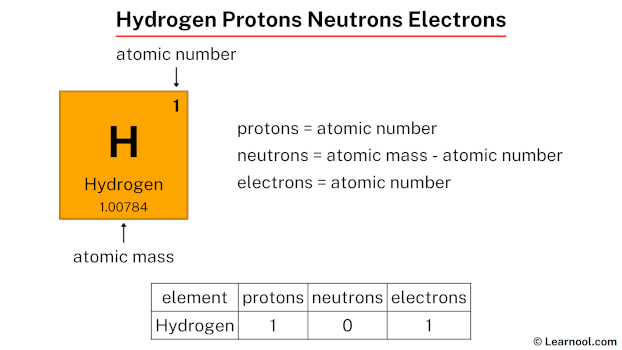 Hydrogen protons neutrons electrons - Learnool
Hydrogen has just one electron, and it's a bit of a rebel. It likes to jump between energy levels, releasing or absorbing photons in the process. This is why hydrogen is such a crucial element in the universe - it's like the original light show, creating the light we see in stars and even in the auroras on Earth!
Putting it All Together
So, there you have it! Hydrogen, protons, neutrons, and electrons are like a band, with hydrogen as the lead singer, protons as the lead guitarist, neutrons as the bassist, and electrons as the groupies. They all work together to create the music of the universe, from the smallest atoms to the biggest stars.
Next time you're at a dinner party, and the host starts talking about atoms, you'll be ready to join in the conversation. Just remember, it's all about the protons, neutrons, and electrons, baby!
