Testing Oxygen Sensor With Multimeter

Oxygen Sensors: The Unsung Heroes of Your Car Ever wondered what's keeping your car's engine from turning into a smoky, coughing monster? Meet the oxygen sensor, your car's v...

Oxygen Sensors: The Unsung Heroes of Your Car
Ever wondered what's keeping your car's engine from turning into a smoky, coughing monster? Meet the oxygen sensor, your car's very own breathalyzer. It's like the designated driver of the engine, making sure it's getting the right mix of air and fuel. But how do you know if it's still got its A-game? Grab your multimeter, and let's find out!
First Things First: What's a Multimeter?
A multimeter is like a magic wand for electricians and DIY enthusiasts. It's a nifty tool that measures voltage, current, and resistance. In simple terms, it's an electrician's Swiss Army knife. If you haven't got one yet, it's high time you joined the club!
Now, let's get back to our oxygen sensor. It's a tiny, ceramic gadget that sits in your car's exhaust manifold, monitoring the oxygen levels in the exhaust fumes. It's like a tiny, always-on breathalyzer for your car. But how do you check if it's still working? That's where our multimeter comes in.
Must Read
Preparation: Gather Your Tools
Before you dive under the hood, make sure you've got your safety gear on. We're talking gloves, safety glasses, and maybe even a face mask if you're working in a tight space. Also, grab your multimeter, a socket wrench, and a ratchet. You might need a torch too, if your garage is as well-lit as a vampire's cave.
Oh, and one more thing. Make sure your car's engine is cool. You don't want to burn your fingers, or worse, cause a fire. Safety first, folks!
 How To Test Oxygen Sensor With Multimeter – JGLXES
Locating the Oxygen Sensor
Now that you're all geared up, it's time to find the oxygen sensor. It's usually located in the exhaust manifold, near the engine. It's a small, cylindrical object with a wire connected to it. Once you've found it, it's time to get your multimeter ready.
Testing the Oxygen Sensor
First, set your multimeter to measure DC voltage. Then, connect the multimeter probes to the sensor's electrical connector. You should see a reading between 0.2 to 0.8 volts. If it's reading 0 or close to it, your sensor might be on its last legs. If it's reading over 1 volt, it could be a sign that the sensor is stuck open.
Now, start the engine and let it warm up. Rev the engine a bit, and watch the multimeter. The voltage should fluctuate between 0.2 to 0.8 volts. If it's not changing, or it's stuck at one voltage, it's a sign that your oxygen sensor is not working properly.
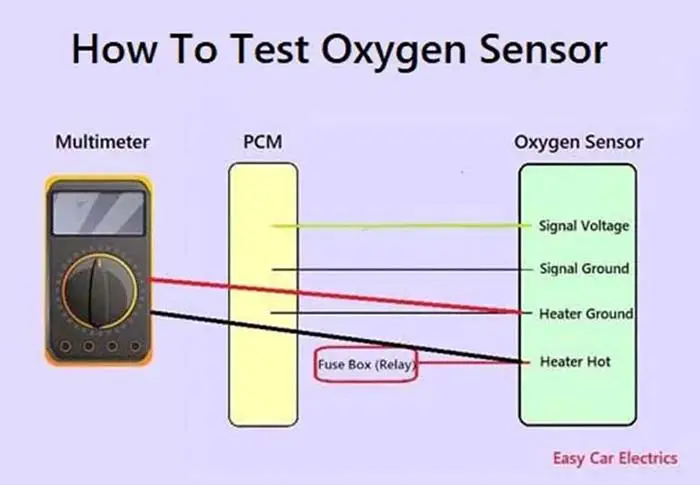 How To Test A 4 Wire O2 Sensor With A Multimeter: Easy Way
Replacing the Oxygen Sensor
If your oxygen sensor is not working, it's time to replace it. It's not as hard as it sounds. Just unplug the old one, unscrew it, and screw in the new one. Make sure to use an anti-seize compound to prevent it from seizing up again.
And there you have it! You've just tested and possibly replaced your car's oxygen sensor. You're now a certified car whisperer, keeping your engine happy and healthy. So, the next time you're cruising down the road, remember, you've got a tiny, ceramic breathalyzer keeping your engine in check. Isn't that just the coolest?
Fun Fact: The Oxygen Sensor's Secret Life
Did you know that the oxygen sensor also doubles as a secret agent? Well, not really, but it does help your car's computer adjust the fuel mixture to optimize performance and reduce emissions. It's like a tiny, always-on eco-warrior, making sure your car is as green as it can be. Pretty cool, huh?
