What Is Bigger Megabytes Or Gigabytes

So, You're Wondering: Megabytes or Gigabytes? Imagine you're at a tech store, trying to decide between two laptops. One's got a shiny '1TB' sticker, the other a humble '512GB'...

So, You're Wondering: Megabytes or Gigabytes?
Imagine you're at a tech store, trying to decide between two laptops. One's got a shiny '1TB' sticker, the other a humble '512GB'. You're thinking, "Hmm, is bigger really better?" Well, let's dive in and figure this out, shall we?
Once Upon a Time in Data Land
Let's rewind to the 1960s. A clever guy named IBM invented something called a 'byte'. It's like a tiny, digital brick that holds a piece of data. Now, you might be thinking, "Why not just call it a 'byte' then?" Well, that's where things get interesting.
You see, our data-loving friends decided to make things a bit more... complex. They started stacking these 'bytes' into bigger piles. A 'kilobyte' (KB) is about 1,000 bytes. Then, they went even bigger with a 'megabyte' (MB), which is roughly 1,000 times larger than a KB. And just when you thought they'd stop, they created the 'gigabyte' (GB), which is about 1,000 times bigger than an MB.
Must Read
Now, Let's Get Real
You might be wondering, "Okay, but what does that mean for my laptop?" Well, let's break it down. A gigabyte is much bigger than a megabyte. In fact, 1GB is roughly equal to 1,000MB. So, that shiny '1TB' laptop has about 1,000 times more storage than the '512GB' one.
But here's the thing, our data-loving friends didn't stop at gigabytes. They went even bigger with 'terabytes' (TB). So, that '1TB' laptop is actually quite spacious in today's standards. It can hold a lot of data - think thousands of high-res photos, or hundreds of movies.
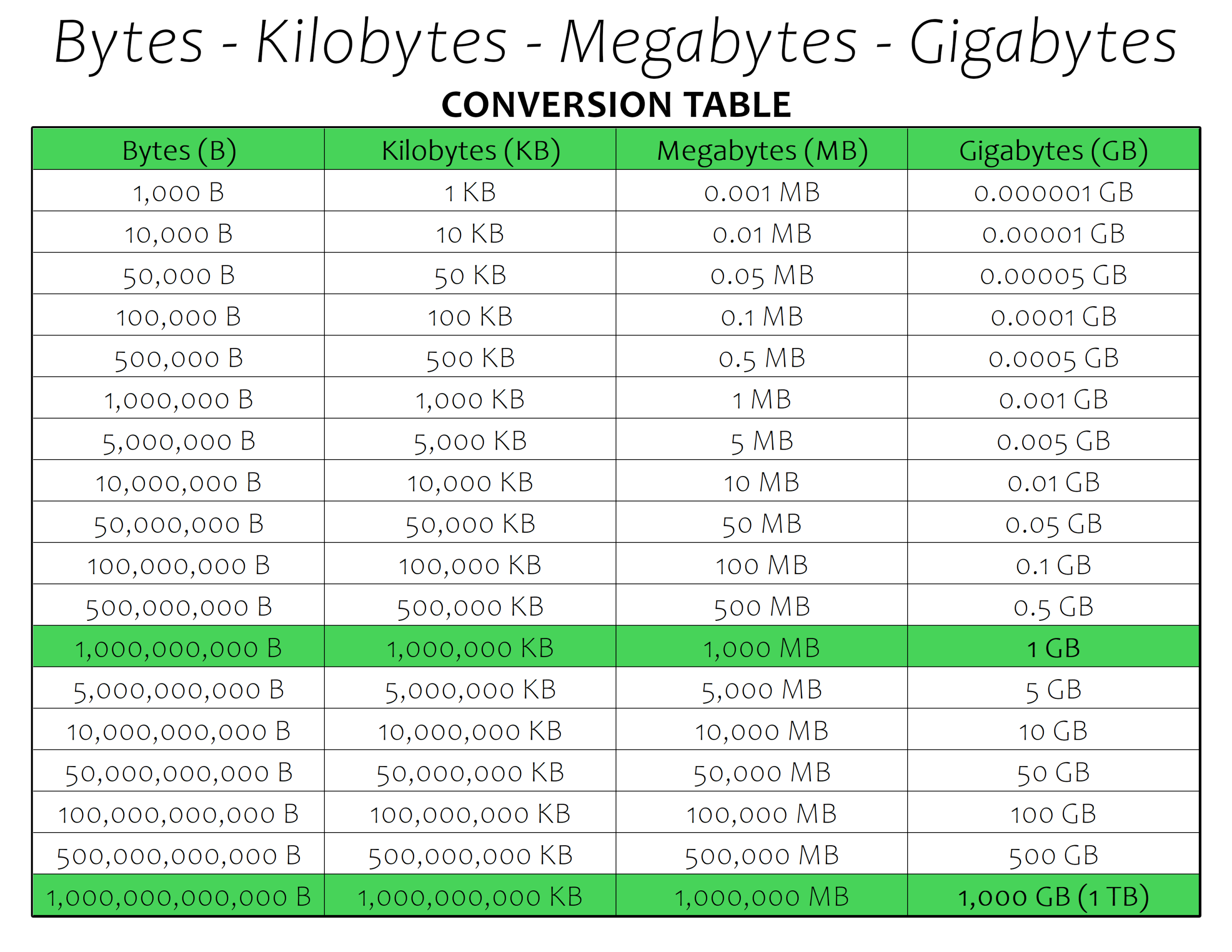 Convert Bytes to Megabytes: Printable Conversion Chart to Calculate
So, What's the Moral of the Story?
When you're looking at storage sizes, remember that gigabytes are much bigger than megabytes. And if you're really into big data, you might even start seeing terabytes. But hey, don't worry if it all sounds a bit confusing. It's like learning a new language - it takes time, and that's okay!
And remember, it's not just about size. Different storage types have different speeds and durability. So, keep an eye out for that too. Now, go forth and make informed tech decisions!
