What Is Chemical Property In Science

Alright, imagine you’re at a party, and you meet someone who’s *way* more interesting than they seem at first glance. That’s kind of what a chemical property is—it’s the "hidd...

Alright, imagine you’re at a party, and you meet someone who’s way more interesting than they seem at first glance. That’s kind of what a chemical property is—it’s the "hidden personality" of a substance that only comes out when it interacts with something else. No small talk here; we’re talking full-on reactions, transformations, and maybe even a little drama.
First things first: what’s the difference between a chemical property and just any property? Think of it like the difference between a regular ice cube and one that’s secretly a spy. A chemical property is something that can only be observed when a substance changes into a new substance. Like when you burn wood—it’s not just getting darker, it’s turning into ash, smoke, and maybe even a sad little pile of regret (if you forgot to check the fire department’s hours).
Let’s Break It Down: The Cool (and Sometimes Wild) Chemical Properties
So, what kinds of things fall under this "hidden personality" category? Well, flammability is a big one—like when you see a match strike and suddenly you’ve got a tiny fireball doing the cha-cha. Not all substances are fans of this dance, though. Some, like water, are more of the "ice queen" type—they’d rather freeze than join in.
Must Read
Then there’s reactivity, which is basically the substance’s way of saying, "Hey, I’d love to hang out with you… but only if we make something new." Take baking soda and vinegar—they’re like the ultimate couple who can’t resist mixing things up. Pop! Fizz! A new substance is born (and your kitchen floor might need a deep clean).
Meet the Stars: Some Famous Chemical Properties
Let’s chat about a few stars of the show. Oxidation is the process where a substance gets all rusty or tarnished, like when your bike chain turns into a space-age alien after a rainy day. It’s like the substance is saying, "I’ve been out too long, and now I’m rusty with life."
Acidity is another one—think of it as the substance’s mood. Lemon juice is the dramatic diva of the fruit world, while baking soda is the chill friend who balances things out. Ever lick a lemon? Yeah, that’s acidity in action (and a quick lesson in why we don’t taste everything).
And who could forget corrosiveness? This is the property that turns substances into Swiss cheese—like when vinegar slowly eats away at your favorite stainless steel spoon. It’s like the substance is whispering, "I’m not here to make friends, I’m here to dissolve them."
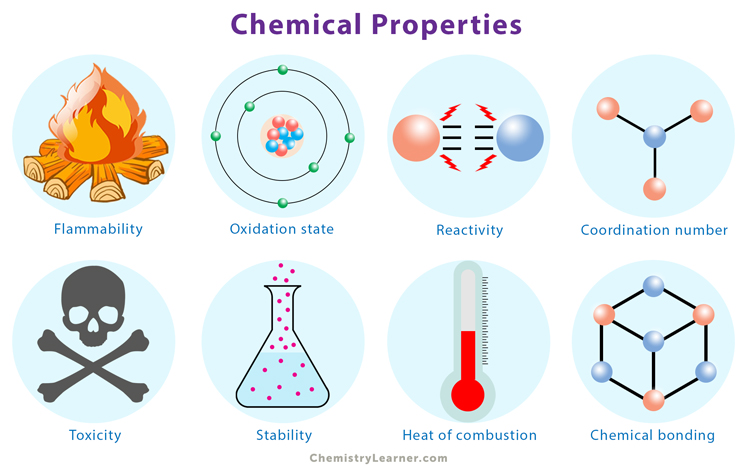 Chemical Properties of Matter: Definition and Examples
Why Should You Care?
Okay, so why does any of this matter? Well, chemical properties are basically the reason we’ve got fireworks, medicines, and even your favorite pizza. Without them, we’d be stuck eating cold, sad slices and watching fireworks fizzle out like a disappointed sparkler.
Ever wondered why some things burn hotter than others? That’s chemistry! Or why your stomach feels like a volcano after eating too much spicy food? Yep, chemical properties again. They’re everywhere, and they’re the reason the world doesn’t smell like a bunch of boring, unchanging rocks.
Fun Experiments to Play With (Safely, Obviously)
Want to see chemical properties in action? Grab some vinegar and baking soda—it’s like the world’s simplest (and messiest) science experiment. Or try mixing hydrogen peroxide with yeast to see some bubbly magic. Just don’t blame me if your sink starts looking like a science lab overnight.
Pro tip: If you’re feeling adventurous, check out electrolysis with water and some batteries. It’s like turning water into its own little superhero team (hydrogen and oxygen, the dynamic duo). Just don’t try this near a spark—unless you’re really into dramatic explosions.
Chemical Properties vs. Physical Properties: The Ultimate Showdown
Sometimes people get confused between chemical properties and physical properties. Physical properties are like the substance’s outfit—color, texture, melting point. Chemical properties? That’s the personality that comes out when they’re stressed (or mixed with something else).
 What is a Chemical Property
For example, melting point is a physical property—like when ice turns into water, but it’s still water. But if you burn wood, it’s not just getting softer; it’s turning into something entirely new (and possibly toxic). That’s a chemical property flexing its muscles.
The Big Picture: Why This Stuff Matters
At the end of the day, chemical properties are what make our world dynamic, interesting, and sometimes a little chaotic. They’re the reason we’ve got rockets shooting into space, batteries powering our phones, and perfumes that make us smell like a summer breeze (or at least like you tried really hard).
So next time you see something fizzing, burning, or dissolving, take a second to appreciate the chemistry behind it. It’s like nature’s way of saying, "Hey, look at me go!"—and honestly, it’s pretty cool.
Final thought: Chemistry isn’t just about lab coats and beakers (though those are fun too). It’s about the little sparks of change that keep the world turning, one reaction at a time. So go ahead, get curious, and maybe—just maybe—you’ll start seeing the world a little differently. And who knows? You might just turn into the next mad scientist your friends secretly admire.
Now go forth and experiment (safely, of course). The world is your chemistry set!
