How Is The Money Multiplier Calculated

Alright, gather 'round, folks. Let's chat about something that sounds as dull as dishwater, but I promise, it's as fascinating as your neighbor's secret recipe for apple pie....

Alright, gather 'round, folks. Let's chat about something that sounds as dull as dishwater, but I promise, it's as fascinating as your neighbor's secret recipe for apple pie. We're talking about the money multiplier. Now, don't go rolling your eyes just yet, because by the end of this, you'll be able to impress your friends with your newfound financial wisdom. And who knows, you might even understand why the bank teller looks at you funny when you ask for a 'money multiplier' instead of a lollipop.
So, What's the Deal with This Money Multiplier Thing?
Imagine you're at a fancy dinner party, and you've got a magic trick up your sleeve. You pull out a $20 bill and say, "Ladies and gentlemen, watch as I turn this single bill into $100!" You pass the $20 to your neighbor, who buys a drink for $20. That drink is then passed to another person who, you guessed it, buys another drink for $20. This keeps happening until, lo and behold, that original $20 has turned into $100. That, my friends, is the basic idea behind the money multiplier.
But How Does the Bank Do It?
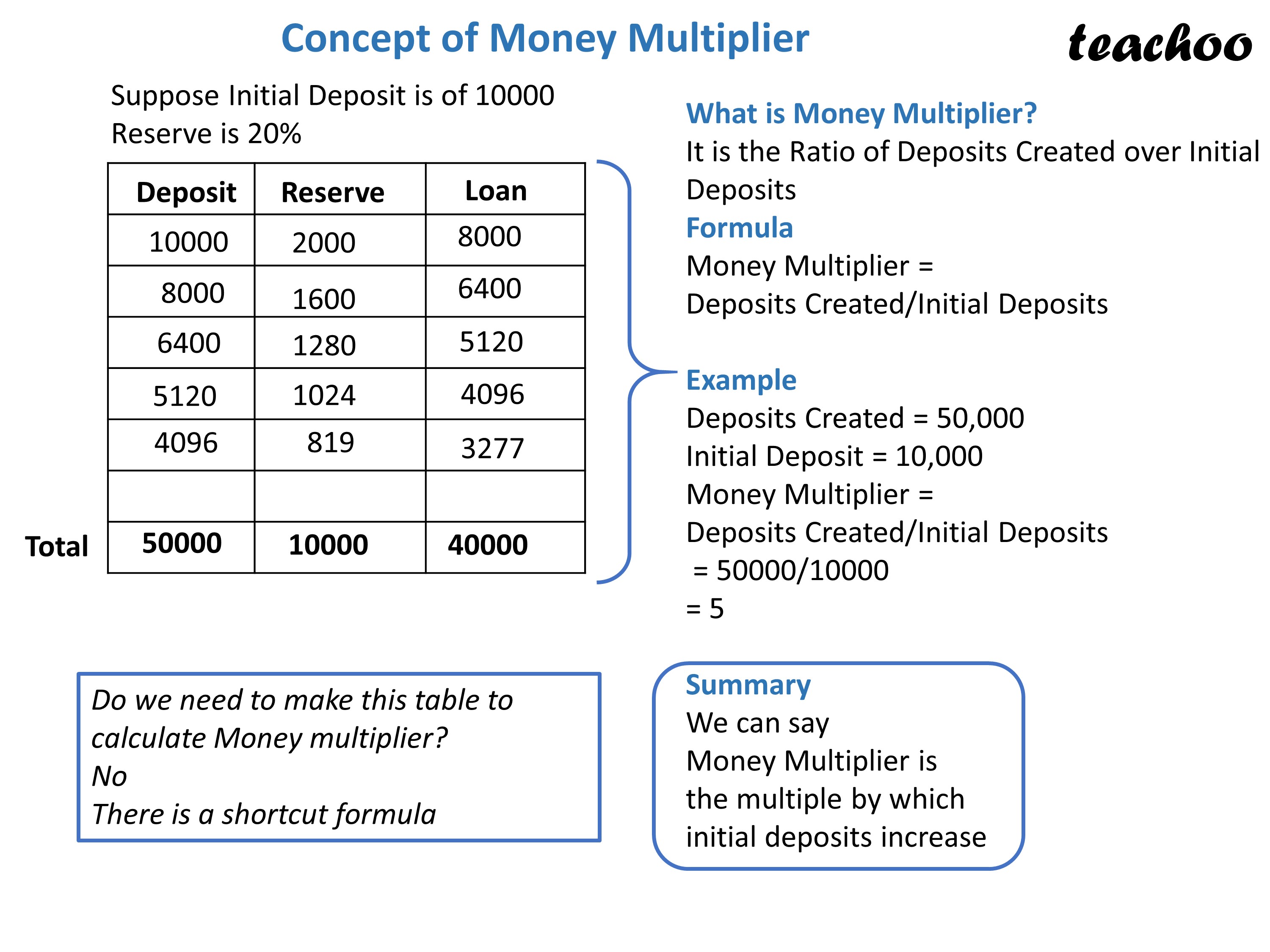
Now, let's bring our magic show to the bank. When you deposit $100 into your account, the bank doesn't just keep that money under a mattress (well, at least we hope not). They lend out a portion of it to someone else. Let's say they lend out $80. That person then spends that $80, and it ends up back in the bank as a deposit. The bank then lends out $64 of that new deposit, and so on. This process keeps repeating, and voila! Your original $100 deposit has turned into $500 in loans. That, in a nutshell, is the money multiplier.
Must Read
But wait, you might ask, "Why would the bank lend out more money than they have?" Well, that's where something called 'fractional-reserve banking' comes in. It's like when you order a large pizza and eat only half, but you still have enough leftovers for lunch the next day. The bank keeps a small fraction of your deposit as reserves, just in case you want your money back. The rest? They lend out to make more money. It's like turning your pizza into a never-ending pizza party.
 Money Multiplier Formula Calculator (Examples With Excel, 43% OFF
Okay, But How Do We Calculate This Magic?
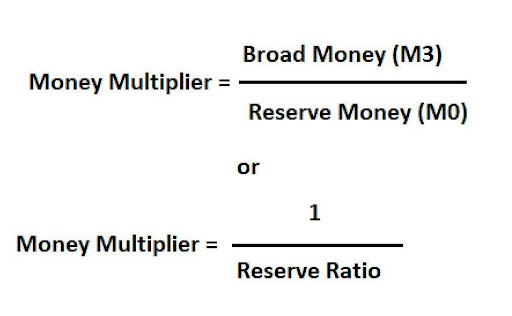
Alright, let's get our hands a little dirty with some math. The money multiplier is calculated using a simple formula: 1 / Reserve Ratio. The reserve ratio is the fraction of deposits that the bank is required to hold in reserve. So, if the reserve ratio is 0.2 (or 20%), the money multiplier would be 1 / 0.2 = 5. In other words, every $1 in reserves can support $5 in loans. It's like having a magic money tree that grows five times the amount you plant.
But remember, this is all in a perfect world. In reality, things get a bit more complicated. There are other factors to consider, like the cash multiplier (which takes into account cash withdrawals and deposits) and the fact that banks don't always lend out the full amount of their reserves. But hey, we're not trying to turn you into an economist overnight. We're just having a chat, remember?
 Money Multiplier Formula Calculator (Examples With Excel, 43% OFF
So, Why Should You Care?
Well, understanding the money multiplier can give you a whole new perspective on how our economy works. It's like finally understanding how your favorite magic trick is done. You might not be able to pull a rabbit out of a hat, but you'll certainly impress your friends with your newfound knowledge. Plus, the next time you hear about quantitative easing or interest rates, you'll have a better idea of what's going on. And who knows, you might even start saving more, knowing that your money could be working a little harder for you.
So, there you have it. The money multiplier, explained in a way that's (hopefully) as painless as a trip to the dentist. Now, go forth and spread your newfound knowledge. Just remember, if anyone asks you to turn their $20 into $100, you might want to direct them to the nearest ATM instead.
