Which Way To Wind A Garage Door Spring

So, you've found yourself in the garage, staring at that intimidating garage door spring, huh? Don't worry, you're not alone. It's like looking at a puzzle piece and wondering...

So, you've found yourself in the garage, staring at that intimidating garage door spring, huh? Don't worry, you're not alone. It's like looking at a puzzle piece and wondering, "Which way does this thing go?" Well, buckle up, my friend. We're about to dive into the fascinating world of garage door springs, and by the end of this, you'll be winding like a pro. Let's get started!
First Things First: What's the Deal with Garage Door Springs?
Garage door springs, they're like the unsung heroes of your garage. You know they're there, you know they're important, but you probably don't give them much thought. Until, of course, they start acting up. Then it's like that one friend who always borrows money and never pays it back - suddenly, you're paying attention.
But seriously, these springs are the backbone of your garage door. They're responsible for lifting and lowering that heavy door, and they do it with the grace of a ballerina and the strength of a weightlifter. Impressive, right? So, let's show them some love and learn how to wind them properly.
Must Read
Alright, Let's Talk Torsion Springs
First things first, we need to identify the type of spring we're dealing with. Most garage doors use torsion springs, which are those long, metal rods that run parallel to the top of your garage door. They look a bit like a giant Slinky, don't they? I mean, if Slinkys were made of steel and could lift a small car.
Torsion springs work on a simple principle: they twist and release energy to lift the garage door. It's like when you twist a rubber band and let it go - that snap! That's the power of a torsion spring. Now, let's see how we can help it do its job.
So, Which Way Do We Wind?
Alright, here's where things get interesting. When it comes to winding a torsion spring, there are two main directions: clockwise and counterclockwise. It's like choosing between chocolate and vanilla - both are delicious, but one might be more suited to your taste.
In the world of garage door springs, the direction you wind depends on which way your garage door opens. Let's break it down:
For Upward-Acting Garage Doors
If your garage door opens upwards (which is the case for most of us), then the spring should be wound in a clockwise direction. This is when you're looking at the spring from above, like you're looking down at a clock. If you imagine the hands of a clock winding clockwise, that's the direction you want to go.
Think of it like this: when you wind the spring clockwise, you're storing potential energy, like a rubber band being stretched. When you release the tension, that energy is used to lift the garage door. It's like a tiny, metal explosion of energy!
For Side-Acting Garage Doors
Now, if you're one of the lucky few with a side-acting garage door (you know, the kind that slides open to the side), then the spring should be wound in a counterclockwise direction. This is when you're looking at the spring from the side, like you're standing next to a clock.
 How to Replace Garage Door Springs - DDM Garage Doors Blog - Dan's
Imagine the hands of a clock winding counterclockwise - that's the direction you want to go. The principle is the same as with upward-acting doors, but the direction is just reversed.
But Wait, What About the Other Kind?
Alright, so we've talked about torsion springs, but what about those other guys? You know, the ones that look like giant rubber bands? Those are called extension springs, and they work a little differently.
Extension springs stretch and release energy to lift the garage door. They're usually found on either side of the garage door, mounted on a track. When it comes to winding extension springs, the direction is less important than with torsion springs. The key is to make sure they're wound evenly and with the right amount of tension.
Now, Let's Talk Safety
Before we dive into the nitty-gritty of winding, let's talk about safety. Garage door springs are under a lot of tension, and that tension can be dangerous if not handled properly. It's like playing with fire - it's exciting, but you've got to be careful.
First things first, make sure your garage door is in the fully closed position. This ensures that the door can't suddenly move while you're working on the spring. Also, it's a good idea to disconnect the garage door opener from the door. This way, the opener can't suddenly decide to lift the door while you're working.
Next, make sure you have the right tools for the job. For torsion springs, you'll need a winding bar (also known as a torque bar). This is a long, metal rod that fits into the holes on the spring. For extension springs, you'll need a winding cone and a pair of pliers.
Lastly, safety glasses are a must. Those little spring coils can go flying like tiny, metal bullets, and you don't want one of them taking out your eye. Trust me, it's not a good look.
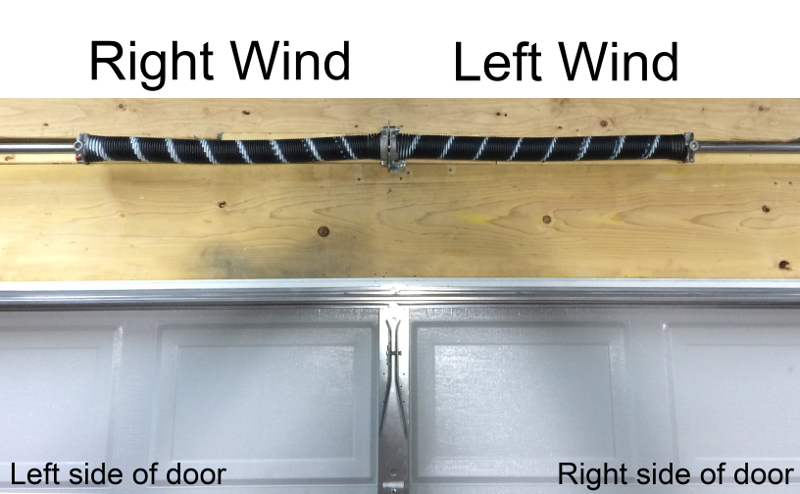
 How to Identify Left & Right Wind Garage Door Springs (Easy Guide)
Alright, Let's Do This Thing
Now that we've got our safety gear on and our tools at the ready, let's wind that spring. Remember, we're looking for a balance between too much tension and too little. You want the spring to have enough power to lift the garage door, but not so much that it's overworking itself.
For torsion springs, start by placing the winding bar into the hole on the spring. Then, start winding the spring in the direction we talked about earlier - clockwise for upward-acting doors, counterclockwise for side-acting doors. You'll feel the spring resist as you wind, and that's okay. Just keep a steady, even pressure.
As you wind, keep an eye on the number of turns. Most garage door springs have a label that tells you how many turns to make. If your spring doesn't have a label, you can count the number of turns it takes to fully close the garage door. That's usually a good starting point.
For extension springs, the process is a bit different. You'll need to wind the spring onto the winding cone, using a pair of pliers to keep the spring in place. Again, you're looking for a balance between too much and too little tension. The goal is to have the garage door lift smoothly and easily.
And That's a Wrap!
And there you have it, folks! You're now a garage door spring winding pro. You've learned about the different types of springs, the importance of safety, and the best way to wind those bad boys. It's like you've just unlocked a secret superpower - the power to control your garage door with the twist of a wrist.
Remember, if you're ever in doubt, it's always a good idea to call a professional. Garage door springs can be tricky, and it's better to be safe than sorry. But with a little know-how and a lot of caution, you can keep your garage door running smoothly for years to come.
So, go forth, garage door warriors! Wind those springs, lift those doors, and conquer the garage. And remember, if you ever find yourself in a garage door spring emergency, you know who to call. (Hint: it's probably not Ghostbusters.)
